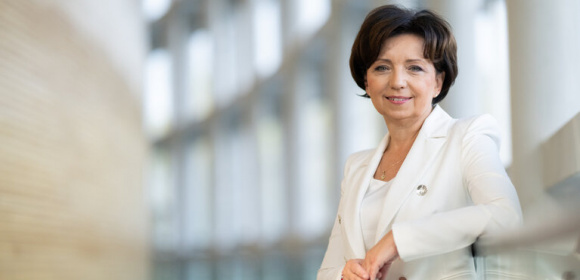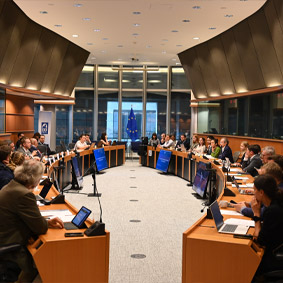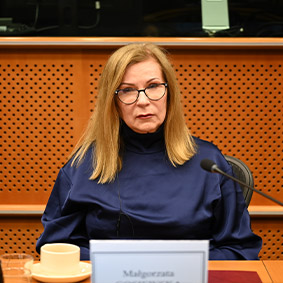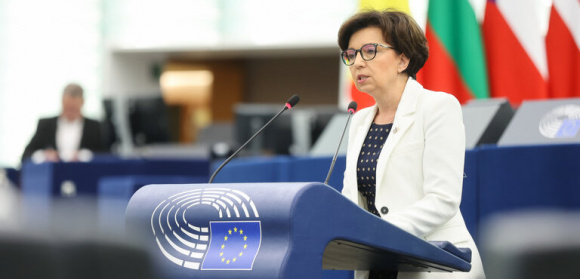
During the European Parliament’s plenary session in Strasbourg and a debate on the urgent need to eliminate economic inequalities in the EU and around the world, PiS MEP Marlena Maląg pointed out that before the European Union attempts to address global issues, it should first effectively take care of its own backyard.
“I have my doubts as to whether we should be addressing inequalities around the world. Before we set out to save the world, let’s take care of our own backyard,” the MEP emphasized.
In her speech, Marlena Maląg painted a picture of a small town in the eastern part of the European Union where a steel mill and a chemical plant had operated for years, providing jobs for entire families. Today—as she noted—the gates of those plants are closed. Production has been relocated, and the costs of energy and excessive regulations have proven too high.
“The father comes home with a layoff notice, the son leaves for the West, and the mother wonders how to support the family. This is what ‘Europe B’ looks like,” she said.
At the same time, new investments are emerging in the “old” EU—semiconductor factories, supported by subsidies, tax breaks, and a steady flow of capital. “Europe A is accelerating, Europe B is slowing down,” she noted.
The MEP pointed out that although we speak of a single market, in reality we are operating in a two-speed Europe. Cohesion policy, which was intended to level the playing field, in practice often exacerbates disparities, leaving peripheral regions with empty production facilities and an aging population.
Marlena Maląg emphasized that economic inequalities stem from social inequalities. Losing a job means losing stability, and a lack of stability causes young people to postpone decisions about starting a family and having children.
“Without families, there are no demographics; without demographics, there is no development. It is the family that builds human capital and the future of Europe,” she noted.
The MEP pointed out that the European Union can no longer pretend that all member states are starting from the same level. “Old and New Europe are not equal today, even though they should be, according to the community’s founding principles,” she said.
In her view, continuing to undermine the industries of peripheral countries and ignoring the role of the family will lead to the entrenchment of a divide between “Europe A” and “Europe B.”
In conclusion, Marlena Maląg called for concrete action instead of yet more declarations. “Europe doesn’t need new slogans. It needs reindustrialization, competitiveness, and sovereign, strong nations. It needs the courage to restore balance, jobs, and respect for families. Otherwise, the common European project may fall apart right before our eyes,” she concluded.