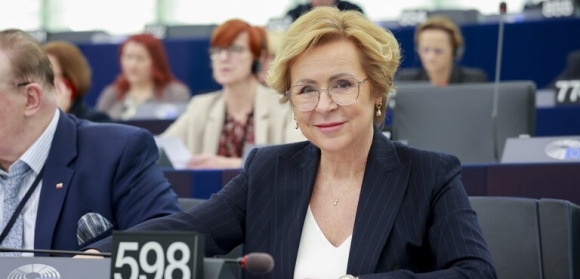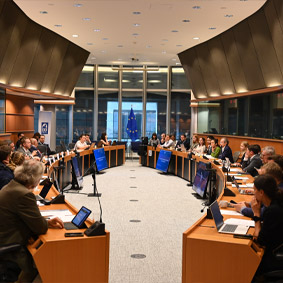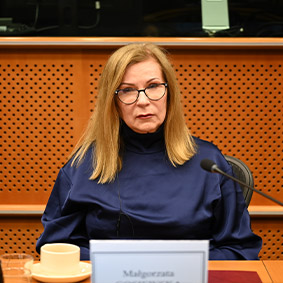
In Strasbourg, on the final day of the European Parliament’s plenary session, a debate titled “Cryptocurrencies—The Need for Global Standards” took place. PiS MEPs Marlena Maląg and Waldemar Buda participated in the discussion.
Marlena Maląg noted that, thanks to the introduction of the MiCA regulations, the European Union has become a global pioneer in regulating the crypto-asset market, effectively bringing it out of the gray market. “We should appreciate the fact that the MiCA regulation introduces reporting requirements, provides for internal control mechanisms, and mandates the separation of client assets from those of cryptocurrency service providers,” stated the MEP. She explained that these are the foundations that ensure greater transparency and investor protection. She noted that the interests of Member States outside the eurozone are also safeguarded.
“Although cryptocurrencies know no borders, we must nevertheless make it clear that differences between countries significantly reduce the attractiveness of this market and slow its development,” said the Polish politician. In this regard, she argued that it is necessary to develop global regulatory standards. “The European Union—although it is a leader in this field—must be careful not to adopt, as usual, an overly restrictive approach that could drive innovation and investment toward more flexible markets outside the European Union,” the Member of the European Parliament noted. She noted that while cryptocurrencies had until recently fueled some investors’ dreams of a financial infrastructure independent of central banks, those dreams have faded somewhat today. She added, however, that cryptocurrencies are and will remain a permanent feature of the global economy.
“Our task is to treat cryptocurrencies as financial instruments that require appropriate regulations, but ones that are similar to those of traditional markets,” she argued. The PiS MEP pointed out that these regulations should ensure investor safety without stifling innovation. “We cannot sleep through this revolution. The future of the cryptocurrency market requires a balance between protecting customer interests and, above all, enabling further development,” she urged.
“Over-regulate, over-regulate, and kill,” said Waldemar Buda, drawing attention to the European Union’s excessive actions on many issues. He recalled that excessive regulations have affected entrepreneurs and farmers. He pointed out that we are now taking exactly the same approach to blockchain and cryptocurrencies. “Soon it will turn out that the whole world is profiting from this, the whole world is growing, and we’re not treating it as an opportunity, but rather as a threat,” the Polish politician commented. He noted that while China and the United States currently hold the largest cryptocurrency assets, it is Europe that is considering how to combat or limit this trend.
The MEP noted that soon one billion people worldwide will own cryptocurrencies, and in Poland, 12 percent of the working-age population already owns them. “I’m more afraid of overregulation by the EU than of its inaction on this matter, because that will likely kill this market and result in others—not Europeans—profiting from it,” said the MEP. He also added that irregularities must be prosecuted, but in a reasonable manner.
“Attempts to regulate the cryptocurrency market in Poland have led to lobbyists ‘taking over’ government offices and institutions, making it difficult to get anything done,” he said. The PiS MEP explained that this situation is leading to a scenario “where those who stand to profit will profit anyway, while ordinary people, unfortunately, will not be able to invest.”