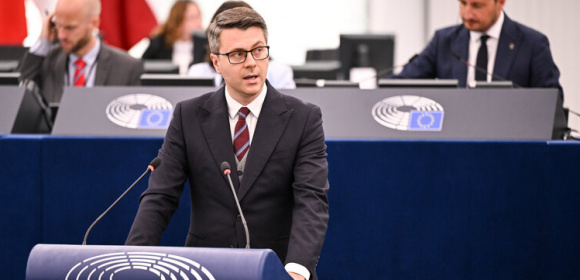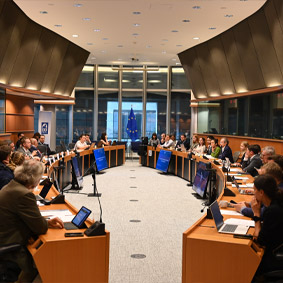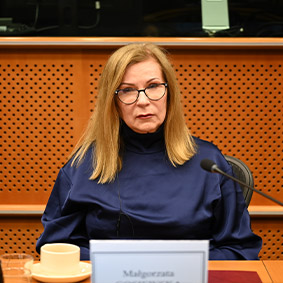
In Strasbourg, during the European Parliament’s plenary session, lawmakers discussed global measures regarding social media platforms, specifically strengthening the role of the Digital Services Act (DSA) and protecting democracy and freedom online. PiS MEPs Piotr Müller, Kosma Złotowski, and Tobiasz Bocheński spoke during the discussion.
Piotr Müller stated that the word “censorship” evokes the worst associations. “Associations with systems that have nothing to do with democracy, with systems that have caused a great deal of harm in Europe—particularly in Central and Eastern Europe,” he recalled. The MEP emphasized that freedom of speech must be a pillar of democracy, and that freedom of speech in the 21st century also means freedom of speech on the internet. “That is why we must closely monitor every action taken by the European Commission and by social media platforms under the DSA package,” the politician noted, recalling that the DSA was intended to protect democratic society from various attempts at influence that might arise. “But shouldn’t we be asking today whether this is part of the introduction of preventive censorship?” the MEP wondered. The Polish politician pointed out that the question now arises as to who is to determine whether, for example, criticizing the migration package—especially in the context of Germany closing its borders—constitutes a fight against disinformation and hate speech, or whether it is simply a legitimate public debate. “We didn’t read Orwell just to now watch the rise of a European ‘Ministry of Truth.’ This cannot be allowed,” he stated.
Kosma Złotowski noted that social media “is a modern, global agora”—a place for commerce, the exchange of views, and political activity, but also an ideal space for spreading disinformation or waging hybrid warfare.
He explained that the goal of regulating this area of the Internet was to ensure better protection of users’ rights and to limit the arbitrary actions of platforms that made decisions—removing content and blocking accounts without justification—based on vague internal rules.
“However, we cannot accept that regulations adopted in good faith are being used as a weapon in political battles,” the politician said, emphasizing that the use of EU regulations as a pretext for interfering in the electoral process must never be allowed to happen again.
“Europe cannot follow the path of undemocratic states and dictatorships, where access to the internet is restricted, content is censored, and the law, instead of protecting citizens, defends only the interests of those in power,” he urged.
Tobiasz Bocheński stated that freedom of speech is “the cornerstone of Western civilization.” He recalled that our ancestors fought for it against oligarchs, tyrants, and other enemies of freedom. “Today we see that freedom is once again under attack, and its enemies have new names: political correctness, hate speech, and government control,” the Polish politician noted. He emphasized that there is no freedom where bureaucrats can dictate the terms of the debate. “We must draft legislation to protect our freedom, because it is now threatened by the arbitrary power of the European Commission,” the MEP urged. He noted with concern that, unfortunately, this power is not subject to any legal constraints. “One of the greatest safeguards against arbitrary power is freedom of speech. Fighting for it is our moral and political duty,” argued the PiS MEP.