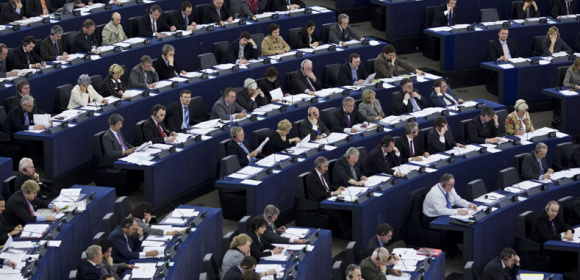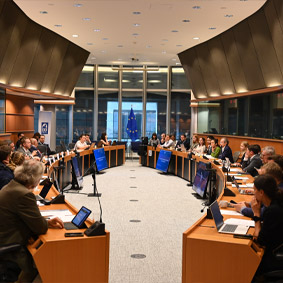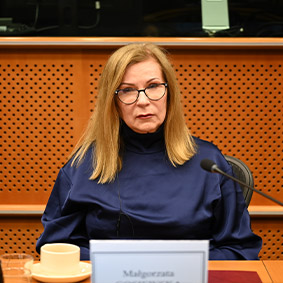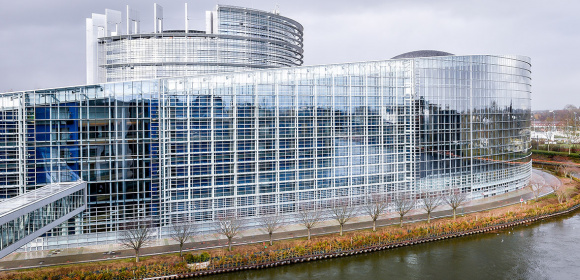
On the third day of the European Parliament’s plenary session in Strasbourg, as part of the debates on violations of human rights, democratic principles, and the rule of law, a discussion was held on the dire situation of political prisoners in Belarus. PiS MEPs Arkadiusz Mularczyk, Małgorzata Gosiewska, Mariusz Kamiński, Michał Dworczyk, and Anna Zalewska took part in the discussion.
“Today, we clearly and firmly condemn the Belarusian regime, which bears joint responsibility for the war in Ukraine,” stated Arkadiusz Mularczyk. He recalled that Russian tanks entered Ukraine from Belarusian territory on February 24, 2022. He noted that the Belarusian regime not only supports Russian aggression against Ukraine but also independently carries out hostile actions against Poland, the Baltic states, and the European Union. “The Belarusian regime is organizing a massive influx of migrants, at the hands of whom Polish officers were killed on the Polish border while defending the Polish border and the European Union’s border,” the MEP said. He noted that the Belarusian regime is also destroying Polish cultural and historical heritage, as well as Polish cemeteries. “The Belarusian regime is destroying people who are inconvenient to it, and one of them is Andrzej Poczobut, who is being held in a Lukashenko-run prison behind Belarusian bars,” the Polish politician pointed out. He also noted that Andrzej Poczobut is fighting for his life and will never give up, and “we will never give up in the fight for his release.” “Long live Andrzej Poczobut and a free Belarus,” he concluded.
Małgorzata Gosiewska noted that today we face an indisputable obligation to express our firm condemnation of the brutal actions of the Lukashenko regime in Belarus. She reported on the situation of 1,347 political prisoners in that country, which is unacceptable and requires an immediate response. The MEP addressed all political prisoners and their families in Belarusian, stating that “we remember those who are imprisoned, and we will fight for their release.” She highlighted the particularly shocking case of Andrzej Poczobut, a man of unyielding character whose life is currently in direct danger. “I know him personally, and I will not rest until he regains his freedom!” Małgorzata Gosiewska emphasized. She reminded the audience that Nobel Prize laureate Ales Bialiatski is also in prison, having been sentenced by the regime to a slow death. The Polish politician also drew attention to the situation of many Christian clergy and believers who have been brutally arrested, punished, or forced to leave their homeland for their courageous opposition to tyranny. “This is not just a violation of human rights; it is an act of terror against its own people!” she emphasized firmly. “Six Belarusian political prisoners have already died or been murdered! This is a disgrace for Lukashenko’s regime,” the Polish politician commented. The MEP called on Lukashenko and his aides to immediately release all political prisoners. “You have a chance—take it. If you don’t, we’ll make sure you end up in The Hague. Your rule won’t last forever!” she warned.
Mariusz Kamiński, at whose request the debate was held, paid tribute to all Belarusian political prisoners. He noted that nearly 1,400 brave men and women fighting for their country’s freedom and independence are currently in prison. The MEP expressed hope that news of this debate and the resolution adopted by the European Parliament in their defense would reach them behind prison walls. “May this debate serve as a signal to them that Europe remembers them, that they are not alone. May it give them strength in their fight for the most important values,” said Mariusz Kamiński. The MEP added that he hopes the voice coming from this chamber will also reach Lukashenko—“a thug who clings to power only through brute force and the Kremlin’s support.” “Lukashenko must be prosecuted for his crimes on the international stage!” he argued, concluding with the call: “Freedom must prevail! Long live Belarus!”
Michał Dworczyk reported that since 2020, when Belarusians rose up en masse against yet another election rigged by the Lukashenko regime, more than 35,000 people have been detained and subjected to beatings, torture, and inhumane treatment, and even murder. He noted that today the Belarusian regime continues to hold over 1,300 political prisoners, denying them basic rights such as the right to medical care and the right to correspond. He noted that among them are, among others, Andrzej Poczobut—a Polish journalist and activist with the Union of Poles in Belarus, who was sentenced in a sham trial to eight years in a maximum-security penal colony— as well as Ales Bialiatski—a Nobel Peace Prize laureate and founder of “Viasna,” the most important human rights organization in Belarus. “Europe must use every means at its disposal to exert pressure on the illegal and criminal Belarusian regime so that political prisoners can regain their freedom,” the Polish politician urged. Michał Dworczyk also argued that Alexander Lukashenko and all those responsible for human rights violations in Belarus must be brought before the International Criminal Court and put on trial. “Long live Belarus!” he concluded, echoing the words of the Belarusian opposition.
Anna Zalewska noted that this was yet another important debate on a resolution concerning political prisoners in Belarus. She added that “in this way, we want to give political prisoners hope that they will live to see not only freedom and democracy in Belarus, but above all, that they will live to see the day when they are free.” “May this hope—that our words will turn into action and that the time will come when they are set free—reach the prisons,” Anna Zalewska said, expressing her support. “As the European Union, we have a wealth of tools and instruments at our disposal; we can act by imposing sanctions and isolating the Belarusian regime so that Lukashenko is in no way legitimized,” stated the Polish politician. In this context, she recalled the European Commission’s “hysteria” during the closure and defense of the Polish-Belarusian border. She noted that the European Commission had allowed Lukashenko and Putin to wage a hybrid war together, adding that these are not the actions needed by those locked up in prisons. “Let’s do this for them—let’s turn words into action,” she urged the EU to take concrete steps.